Guides
Tow truck accident documentation: records to keep
Tow truck accident documentation covers scene photos, dispatch and police records, cargo evidence, and FMCSA accident-register and post-crash testing rules.
What to take away
- For tow truck accident documentation, start the file at the scene with photos of both vehicles, plates, cargo, the road surface, and traffic control before anything moves.
- Write the incident report during the same shift, while dispatch times and duty status still match the GPS record.
- Photograph the load, the securement points, and the damage from three angles before the customer signs a release.
- Keep one folderdispatch log, driver statement, police report number, witness contacts, and repair or cargo estimates.
- Save the insurer's claim number, notice confirmation, and submission instructions in the same file.
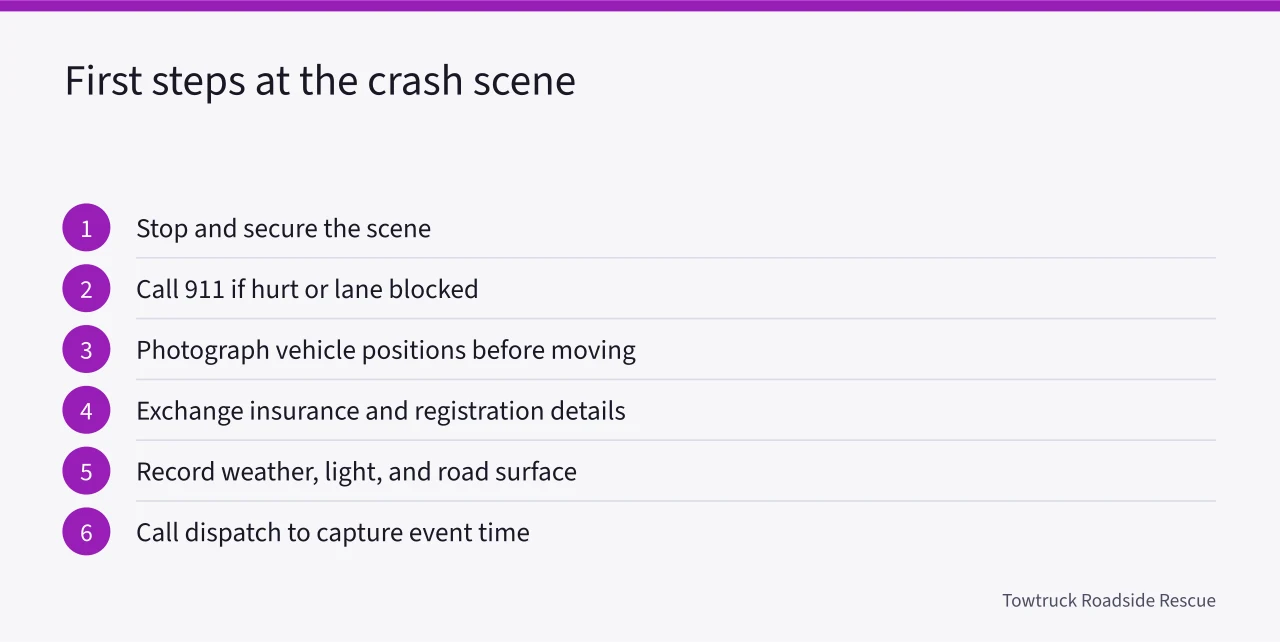
The first steps at the crash scene
- Stop and secure the scene. Call 911 if anyone is hurt or a travel lane is blocked.
- Photograph vehicle positions before either unit moves, including debris, skid marks, and cones.
- Exchange insurance and registration details, and note the other driver's license class and endorsements.
- Record weather, light, and road surface conditions, since recovery work on ice changes the liability picture.
- Call dispatch so the management system captures the event time, truck number, and location.
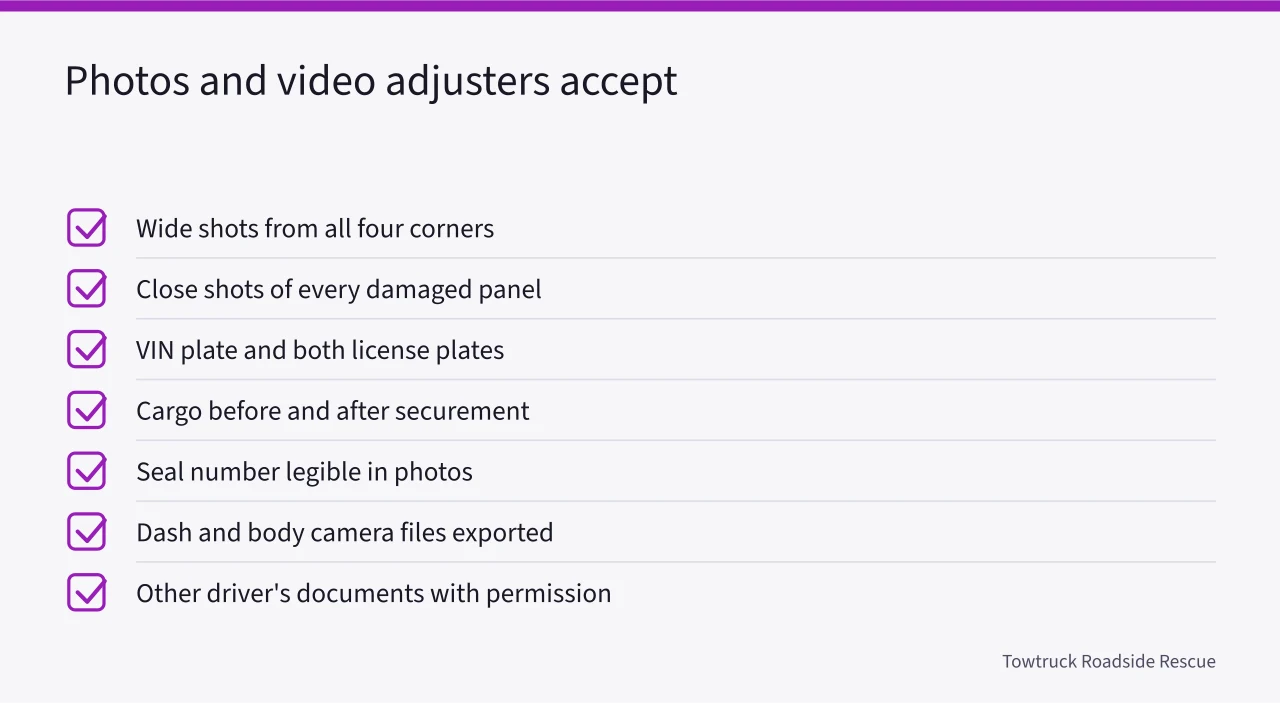
Photos and video adjusters accept
- Wide shots from all four corners of the scene
- Close shots of every damaged panel, the VIN plate, and both license plates
- Cargo photos before and after securement is released, with any seal number legible
- Dash camera and body camera files exported before the recording loop overwrites them
- Photos of the other driver's documents, taken with that person's permission
Incident report fields that carry a claim
| Field | What the adjuster matches it against |
|---|---|
| Collision time and dispatch time | GPS pings and duty status entries |
| Truck number, plate, and configuration | The unit listed on the policy |
| Load description, weight, and value | Cargo liability limits |
| Securement method | Equipment failure compared with loading error |
| Witness names and phone numbers | Statements from the other party |
Write the narrative in the driver's own words. Keep times and locations specific enough to line up with the dispatch log, because an adjuster will compare the two.
Incident report fields and matches
Field
- Collision time and dispatch time
- GPS pings
- Truck number, plate, configuration
- Unit on policy
- Load description, weight, value
- Cargo liability limits
- Securement method
- Equipment failure vs loading error
- Witness names and phone numbers
- Statements from other party
Adjuster matches against
- Collision time and dispatch time
- Duty status entries
- Truck number, plate, configuration
- Load description, weight, value
- Securement method
- Witness names and phone numbers
Example: a wheel-lift drops a vehicle at delivery
A car slides off the grid at the delivery address, and the owner files a damage claim the next morning. Pickup photos show a clean rear bumper; delivery photos show a creased quarter panel. Those two images decide the claim.
Record the truck configuration too, since tow truck types such as flatbed and wheel-lift leave different damage patterns and different defenses.
If nobody photographed the vehicle at pickup, expect the carrier to argue the damage happened earlier.
Roadside assistance calls and third-party liability
Roadside assistance programs often dispatch work through a motor club or a fleet contract rather than a direct call from the owner. That contract decides who handles a damage claim and which insurer sees it first.
Keep the dispatch record for those jobs. A club call and a private call follow different claim paths, and the file has to show which one it was.
Insurance and cargo claim records
Save the relevant policy declarations and endorsements, the insurer's claim number, and confirmation of when and how you gave notice. For carriers subject to federal financial-responsibility requirements, the liability policy may include an MCS-90 endorsement; keep a copy with the file. The MCS-90 is an endorsement, not a claim form or a guarantee that a particular loss is covered.
For cargo damage, ask the cargo owner, shipper, or contracting party which cargo claim or overage, shortage, and damage (OS&D) form it requires; there is no single form for every job. Record the shipment or load identification, affected items and quantities, condition at pickup and delivery, seal number, dates, delivery exceptions, parties notified, photos, and estimates.
Police reports, witnesses, and dispatch logs
Get the report number before leaving the scene, then request the full report once it is released. Officer notes carry weight that a driver statement alone does not.
Driver duty status matters after a collision. The federal hours-of-service rules govern duty-status records for covered drivers. Preserve the applicable log or electronic record and compare it with dispatch and GPS timestamps.
FMCSA accident records and post-accident testing
For a motor carrier subject to FMCSA rules, 49 CFR 390.15 requires an accident register for crashes meeting the definition in 49 CFR 390.5. A DOT-recordable crash involves a commercial motor vehicle operating on a highway in interstate or intrastate commerce and results in a fatality, bodily injury requiring immediate medical treatment away from the scene, or disabling damage that requires a vehicle to be transported away. The register must include the date and location, driver, number of injuries and fatalities, and whether covered hazardous material was released; retain it for three years and keep required accident-report copies.
Under 49 CFR 382.303, post-accident testing applies to covered employers and drivers after a qualifying crash involving a commercial motor vehicle on a public road in commerce. Testing is required after a fatal crash, or when the driver receives a qualifying citation and the crash involves an injury requiring immediate medical treatment away from the scene or disabling damage requiring a tow. Conduct alcohol testing as soon as practicable; if it is not completed within two hours, document why and continue attempts, stopping after eight hours. Conduct drug testing as soon as practicable and no later than 32 hours; document why if it is not completed.
Collect witness names and numbers at the scene, and check how long the dispatch platform keeps call audio. Some systems overwrite it in 30 days or less.
Keep towing authorization records with the claim file
For a Texas private-property tow, keep the signed authorization, signage records, and TDLR tow ticket with the accident file when relevant. These records help document the assignment but do not replace scene evidence, an incident report, or insurer notice.
For cross-border work, the Ontario Towing and Storage Safety and Enforcement Act is separate from U.S. accident-reporting rules. Do not use it to determine what a U.S. claim file requires.
Keep a separate record for each accident
A storm deployment can create multiple incident files. Tie each crash to its own truck, driver, dispatch assignment, location, and time; staging sites provide context but do not replace individual accident records.
Files built at the scene survive that crush. Files rebuilt a week later rarely do.
Record the specific dispatch assignment
Broader towing company demand in 2027 may change assignment volume, but each crash file should capture the actual dispatch instruction, truck, driver, location, and work performed.
Keep the assignment details with the incident report so the file shows why the truck was at the scene and what service it was performing.
Keep the file current
A daily operating checklist can include confirming that incident records, dispatch details, and required camera downloads are saved to the correct file.
Add one line to that routine: confirm the camera dock downloaded the last shift's footage.