Guides
Towing company equipment: how calls, ratings and brands guide the choice
A guide to choosing towing company equipment based on your calls, the major brands, three key ratings, and new versus used math you run yourself.
What to take away
- Match the chassis to the heaviest routine call, not the heaviest call you have ever taken.
- A wheel-lift and a flatbed earn differently; buy the one your rotation and retail mix pays for.
- Miller Industries builds Century, Vulcan, Holmes and Chevron, so several "brands" are one factory.
- Gross vehicle weight rating, axle rating and boom rating are three separate limits. All three must clear the job.
- Ask the dealer for the body builder's rating sheet in writing before you sign.
This article covers business and equipment decisions, not recovery technique. For rigging, scene safety and operator competence, use certified towing and recovery training and your state or provincial safety authority. Licensing, permits, insurance and tax questions belong with the authority that issues them and a licensed attorney or accountant.
Start with the calls, not the catalogue
Write down every call from the last ninety days: vehicle class, loaded weight, distance, whether it was a wheel-lift job or a flatbed job, and who paid. That list, not a national ranking, tells you what to buy.
Match truck class to call mix
Most calls under 6,000 lb?
light-duty wrecker, 4-ton boom
medium-duty for box vans
If 80 percent of your calls are sedans and crossovers under 6,000 pounds, a light-duty wrecker with a 4-ton boom handles the work. A medium-duty truck bought for the occasional box van sits idle and eats insurance.
The reverse mistake costs more. A light-duty truck sent to a loaded pickup or a van with a full cargo bay is over its rating, and the driver finds out on a hill.
The brands and what each one is for
| Brand | What it builds | Who it suits |
|---|---|---|
| Miller Industries | Parent of Century, Vulcan, Holmes, Chevron and Jerr-Dan | Buyers who want parts and service depth |
| Jerr-Dan | Carriers and wreckers, light through heavy | Mixed retail and contract fleets |
| NRC Industries | Sliding rotators and heavy wreckers | Heavy recovery and police rotation work |
| Century | Light and medium wreckers, flatbeds | General light-duty service |
| Vulcan | Light-duty wreckers and carriers | Owner-operators adding a first truck |
| Holmes | Light and medium wreckers | Long-established light-duty operations |
| Landoll | Traveling axle trailers and lowboys | Equipment hauling, not vehicle towing |
| Hino | Cab-over and conventional chassis | City work where turning room is tight |
| Freightliner | M2 and SD chassis | Medium-duty wreckers and carriers |
| Peterbilt | Medium and heavy chassis | Heavy wreckers and rotators |
| Kenworth | T370 and T880 chassis | Heavy recovery and long-haul transport |
Miller Industries owns Century, Vulcan, Holmes, Chevron and Jerr-Dan. Comparing those five as separate makers is comparing one factory's product lines, and the dealer network overlaps.
NRC builds sliding rotators for heavy recovery. If your rotation list includes tractor-trailers, that is a different purchase from a light-duty wrecker, and a different insurance conversation.
Landoll does not build tow trucks. It builds traveling axle trailers and lowboys for hauling equipment, which is a separate line of business with its own rates.
On the chassis side, Hino, Freightliner, Peterbilt and Kenworth supply the cab and frame. The wrecker body, boom and wheel-lift come from the builder, so the rating that matters is the completed unit, not the chassis alone.
Three ratings that must all clear the job
Gross vehicle weight rating is what the finished truck may weigh loaded, including fuel, tools and the driver. Axle rating is what each axle may carry. Boom rating is what the recovery equipment may lift at a stated reach.
Three ratings that must clear
- GVWRfinished truck loaded, fuel, tools, driver
- Axle ratingwhat each axle may carry
- Boom ratinglift at stated reach
- Get body builder's rating sheet before signing
- Keep sheet for insurer and state DOT
A truck can pass one and fail another. A heavy chassis with a light boom cannot lift the load. A strong boom on an overloaded rear axle damages the truck and puts the driver outside the law.
Ask for the body builder's rating sheet before you sign. It states capacity at reach, and it is the document your insurer and your state DOT will want to see.
New or used, and what the numbers look like
For the arithmetic, use variables you fill in yourself.
Break-even math for a tow truck
- Loan paymentmonthly loan cost
- Insurance + maintenance / 12monthly fixed cost
- Total monthly cost / average revenue per callcalls needed to break even
- 150,000 milesused wrecker odometer
Total monthly cost is the loan payment plus insurance and maintenance divided by twelve.
Divide that by your average revenue per call to get the calls per month the truck must run to break even.
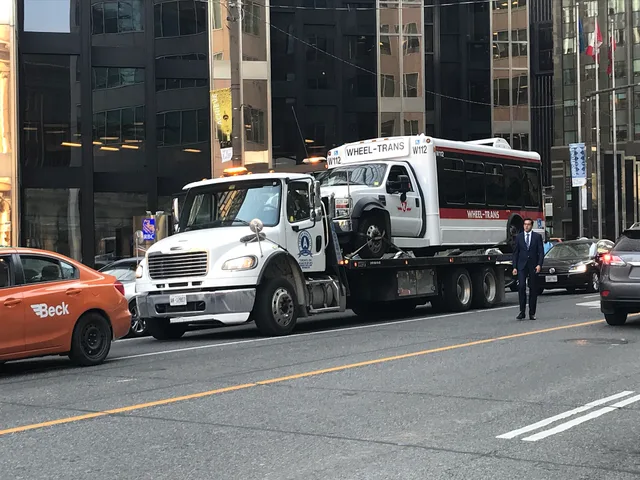
A used wrecker with 150,000 miles costs less up front and more per month in the shop. A new truck costs more up front and carries a warranty. Neither is right until you know your call volume.
The new versus used towing equipment cost comparison walks through that arithmetic with the same variables.
Where the equipment decision sits in the business
Equipment is one line in a setup that also covers dispatch software, impound storage, permits and staffing. The towing company equipment and setup guide covers how those pieces fit together.
Keep records that show what each truck earned and what it cost. The IRS page on what records a business should keep explains the standard: a system that clearly shows income and expenses, with documents supporting purchases, payroll and assets.
Cargo securement rules apply to what you haul, and the FMCSA cargo securement rules set the interstate requirements. Applicability depends on your operation, so check it against your authority.
A written safety and health program is a checkable starting point, and OSHA's safety management guidance describes finding and fixing hazards before an inspection does it for you.
Common questions
Do I need a rotator if I already run a heavy wrecker?
Only if your call mix includes overturned or badly positioned tractor-trailers. A rotator costs far more than a heavy wrecker and needs a trained operator to earn its keep. Check your last year of calls before committing.
Can I run a light-duty wrecker and a flatbed off one truck?
No. They are different bodies on different chassis, and the wheel-lift cannot carry what the flatbed carries. Many small fleets start with one and add the other once call volume justifies it.
How do I compare two quotes for the same class of truck?
Put the completed unit's gross vehicle weight rating, axle ratings and boom rating side by side, then add insurance, maintenance and financing to each. The lower purchase price often loses on total monthly cost.
![[Hurricane Katrina] Pass Christian, Miss., January 17, 2006 -- Wrecker driver Johnny Hogan looks on as a used wrecker donated by the California Tow Truck Driver's Association is delivered. Mr. Hogan lost his wrecker due to Hurricane Katrina. Mark Wolfe/FEMA. Should a towing company buy new or used equipment for owner-operators](/covers/new-vs-used-towing-company-equipment-cost-guide-640.webp?v=96426914)